Short answer
Gout medicines have different jobs: treat pain and inflammation during a flare, protect the transition while urate is changing, lower long-term crystal burden, and notice other medication or hormone changes that move the system. Urate-lowering therapy is not a pain-now medicine, and flare medicine does not by itself remove the long-term crystal problem. Individual start, stop, raise, lower, or combine decisions belong inside the prescribing relationship, but you can bring better fit checks: serum urate trend, kidney function, interaction list, hormone timeline, and rescue response.
Evidence label: medication categories, target logic, monitoring, and label warnings are current-care or label anchors; hormone and frontier pathway claims are human-adjacent or mechanism-source unless named otherwise.
Start with the job:
- Is this for pain and inflammation during a flare?
- Is this for transition protection while urate is moving?
- Is this for lowering urate over time?
- Is another medication or hormone change moving the gout system?
The map
| Lane | Job | Examples |
|---|---|---|
| Flare treatment | interrupt pain and inflammation now | NSAIDs, colchicine, corticosteroids, selected IL-1 beta blockade |
| Transition protection | reduce flares while urate is changing | colchicine, low-dose NSAID, sometimes low-dose steroid depending on fit |
| Urate lowering | lower the long-term crystal burden | xanthine oxidase inhibitors, uricosurics, uricase therapy |
| System-changing meds | notice medicines that move urate, inflammation, hormones, hydration, or rescue fit | diuretics, aspirin, niacin, immune meds, TB meds, hormone therapy, metabolic drugs |
| Research/frontier | recognize useful names and ask sharper specialist questions | direct NLRP3 inhibitors, gut-lumen uricase, engineered organisms, repurposed inflammatory-pathway drugs |
Evidence label: the first four lanes are current-care or label-supported categories when tied to a specific medicine source. Research/frontier entries are not current-care instructions.
Flare medicines: interrupt inflammation
Flare medicines are for the inflammatory event. They can reduce pain and swelling without fixing the long-term urate problem.
| Category | What it targets | Fit checks | Evidence label |
|---|---|---|---|
| NSAIDs | COX-driven pain and inflammation | kidney function, stomach bleeding/ulcer history, blood pressure, heart risk, anticoagulants, alcohol pattern | current-care category |
| Colchicine | microtubules and neutrophil movement, with downstream NLRP3/ASC-speck and P2X7/K-efflux effects | kidney/liver function, GI tolerance, CYP3A4/P-gp interactions, macrolide antibiotics, azole antifungals, calcineurin inhibitors | current-care plus label warnings; mechanism layer explains pathway |
| Corticosteroids | broad inflammatory signaling | glucose, blood pressure, sleep, mood, infection context, repeated-course burden, rebound pattern | current-care category |
| IL-1 blockers | IL-1 beta signaling downstream of NLRP3 | infection risk, access, cost, injection route, whether NSAIDs/colchicine/steroid courses fit poorly | selected current-care or label-supported use, access-dependent |
Ask:
- "Which flare category fits my kidney, stomach, blood pressure, diabetes, immune, and interaction context?"
- "How early should I use the rescue plan when I feel my usual prodrome?"
- "If I keep needing rescue, what prevention decision does that trigger?"
Mechanism note: colchicine maps to microtubules, ASC specks, P2X7 signaling, and neutrophil behavior. Use that as pathway literacy, not a custom dosing rule.
If colchicine is part of your rescue plan, bring one sharp question: "Does my prescription match the modern low-dose AGREE-trial pattern, and do my kidney, liver, or interaction risks change that plan?" The site cannot individualize the dose. The useful move is making sure the plan is written, early, and modern.
IL-1 blockers are a real recurrent-flare conversation
IL-1 blockers are not just a vague last resort. They target the IL-1 beta signal downstream of NLRP3, one of the main inflammatory messages in a gout flare.
Anakinra (Kineret) is the practical name to know for recurrent or hard-to-fit flares. Practical gout writeups commonly discuss 100 mg subcutaneous daily for 3 days; published trial and evidence-review protocols also include 100 mg daily for 5 days. That belongs in a written prescribing plan. The point is to ask about the category when NSAIDs, colchicine, repeated steroid courses, or steroid rebound fit poorly.
Why it matters: if someone is stacking prednisone courses year after year, the comparison is not only "which drug lowers pain today?" It is cumulative burden: glucose, blood pressure, mood, sleep, bone, cataract, infection context, and rebound pattern. In the anaGO randomized trial, anakinra and intramuscular triamcinolone had similar single-flare pain reduction. That makes the better patient question: does IL-1 blockade change the long-term rescue strategy for recurrent severe flares?
Anakinra can interrupt the index flare, but relapse can still happen if the prevention plan is not moving. Ask:
- "I keep needing steroids. Would an IL-1 blocker such as anakinra ever fit my recurrent-flare plan?"
- "If we use an acute IL-1 option, what prevention or transition-protection plan keeps this from rebounding?"
- "What infection risk, insurance, injection, and cost realities decide whether this is realistic?"
Evidence label: anakinra for gout flares has human gout trial and series evidence, and Kineret has a current drug label for other inflammatory indications. Gout use is specialist and access-dependent, not a consumer product lane.
Urate-lowering medicines: change the crystal system
Urate-lowering therapy is for the long game: keeping serum urate below the crystal-forming range long enough for deposits to stop forming and, over time, dissolve.
| Category | What it does | Fit checks | Evidence label |
|---|---|---|---|
| Xanthine oxidase inhibitors | reduce urate production. Main examples: allopurinol, febuxostat | serum urate trend, kidney function, liver tests, rash history, ancestry/HLA-B*58:01 context for allopurinol, cardiovascular history for febuxostat | current-care guideline category |
| Uricosurics/URAT1 inhibitors | increase kidney urate excretion. Main example in US practice: probenecid | kidney function, stone history, urine uric acid context, drug interactions | current-care category, fit-dependent |
| Uricase therapy | enzymatically converts urate toward allantoin. Main current gout example: pegloticase | severe/refractory gout context, infusion plan, G6PD screening, serum urate before infusions, anti-drug antibody signal | label-supported specialized care |
Current-care baseline: gout is usually treated below 6 mg/dL. NICE also names below 5 mg/dL for some people with tophi, chronic gouty arthritis, or frequent flares despite being below 6.
Evidence label: serum-urate targets, treat-to-target monitoring, allopurinol/febuxostat/probenecid category framing, HLA-B*58:01 context, and pegloticase monitoring are current-care or label-anchor claims.
HLA-B*58:01 matters because carriers can have a rare but severe allopurinol reaction, including Stevens-Johnson syndrome, toxic epidermal necrolysis, or DRESS. In the US, ACR names Southeast Asian ancestry and African American patients as groups where testing before allopurinol should be discussed. Some countries and health systems have moved toward broader pre-allopurinol screening.
Ask:
- "What serum urate target are we treating to?"
- "When will we recheck serum urate, and what change happens if I am still above target?"
- "What flare-protection plan fits the start or titration window?"
- "If I reach target but still flare, what is the next thing to evaluate: crystal burden, same-joint damage, imaging, urate handling, or inflammation?"
Startup flares are a transition problem
Starting or changing urate-lowering therapy can trigger flares because the crystal system is moving. That does not automatically mean the medication is wrong. It means the transition needs a plan.
One question belongs in the plan before the first dose: "If I flare after starting allopurinol or febuxostat, should I keep the urate-lowering medicine steady while we treat the flare, and what would make us pause or change it?"
Common transition-protection categories include colchicine, a low-dose NSAID, or sometimes a low-dose steroid when the fit makes sense. The category depends on kidney function, stomach bleeding risk, diabetes risk, blood pressure, interactions, and prior response.
Evidence label: ULT transition flares and prophylaxis categories are current-care guideline material. The question here is planning and monitoring, not a reader-led dose change.
Track:
- start date or dose-change date
- serum urate values and dates
- flare dates, joints, severity, rescue response, and transition-protection plan
- side effects or reasons stopped
- next recheck date
Ask:
- "What is the transition-protection window for me: until target urate is reached, at least the first 3-6 months, or longer if flares continue?"
- "What is the plan if I flare while urate is coming down?"
- "At what point does the flare pattern mean we adjust the prevention plan?"
Other medications can move the gout system
Some medications are not gout medicines but still change the gout landscape. They may affect urate production, kidney clearance, gut clearance, hydration, weight change, immune signaling, or rescue-med fit.
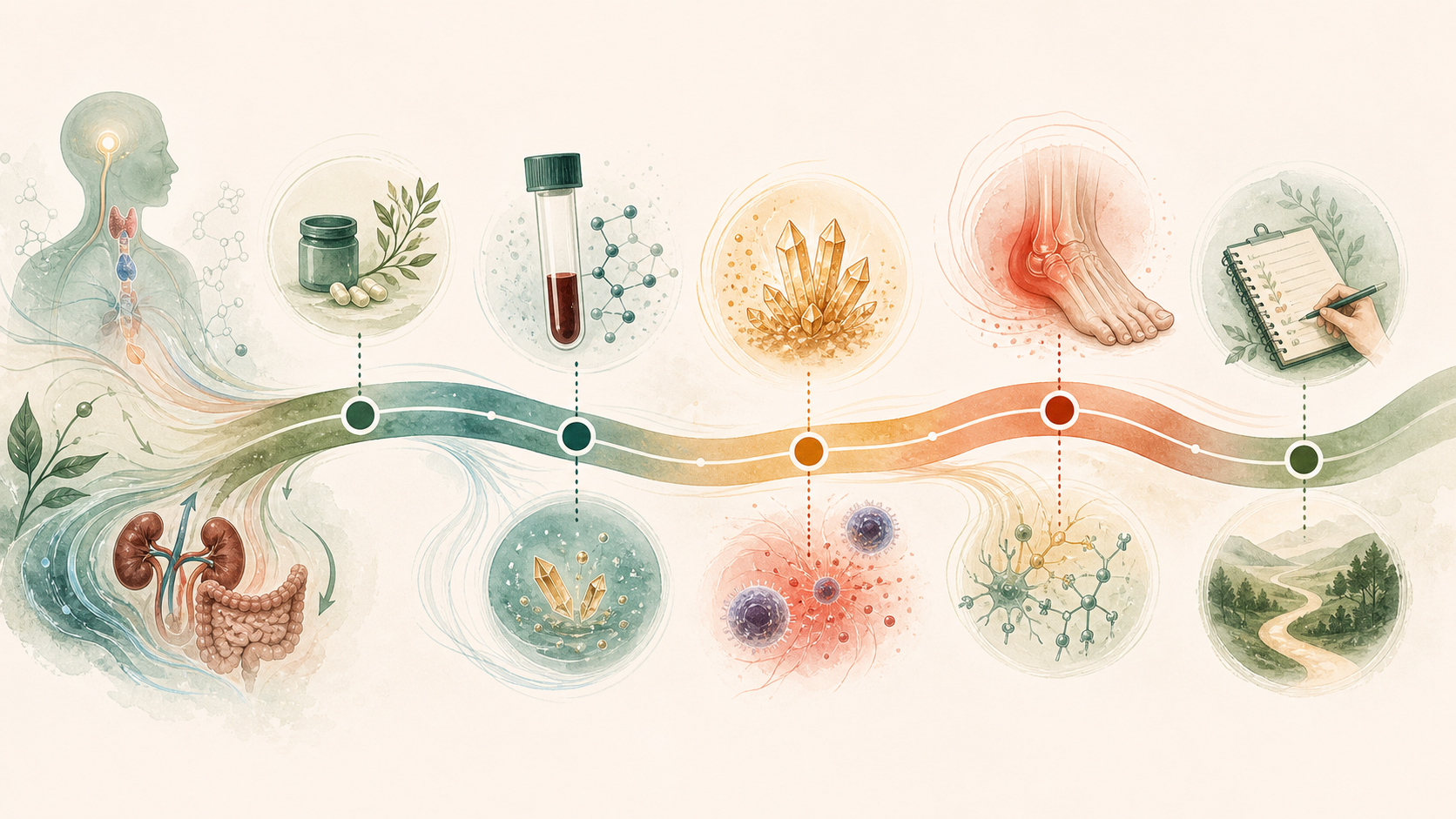
Examples worth logging:
- diuretics
- low-dose aspirin
- niacin
- cyclosporine, tacrolimus, and other immune medicines
- pyrazinamide, ethambutol, and other medicines known to affect urate handling
- testosterone therapy, anabolic steroids, SERMs, aromatase inhibitors, and postmenopausal hormone therapy
- SGLT2 drugs, GLP-1 drugs, weight-loss medicines, or major weight-change interventions
- antibiotics, antifungals, heart medicines, or antivirals that interact with colchicine pathways
- possible urate-lowering shifts such as losartan, some calcium-channel blockers, SGLT2 inhibitors, and fenofibrate, with fenofibrate not being a reason by itself to change lipid therapy
Use this as a timeline list, not a stop list.
If a medicine is protecting your heart, transplant, cancer treatment, infection treatment, or another high-stakes condition, the gout question is not "can I drop it?" The better question is: "what else in the gout plan changes because this medicine matters?"
Evidence label: specific medication risk, interaction, and monitoring claims should be tied to current-care sources or labels. The list is a prompt for timeline review, not a stop/change instruction.
Bring:
- medication or hormone name
- dose or product, start/stop/change date, urate before and after if available, flare timeline, kidney function, relevant labs, rescue response
Ask:
- "Could this medication, dose change, or hormone shift be affecting serum urate, flare risk, kidney handling, inflammation, or my rescue-med options?"
- "What labs should we monitor, and when?"
- "If this medicine needs to stay, what gout lever should move around it?"
Hormones deserve a real question
Hormone context is part of gout biology. Mechanism sources link sex hormones to renal urate transport, intestinal ABCG2 context, SHBG, estradiol signaling, and possibly inflammation. The evidence is not one clean arrow. Tissue context, formulation, and baseline metabolic state can change the read.
Evidence label: menopause and gender-affirming hormone therapy claims are human observational or human-adjacent, depending on the study. Androgen-urate pathway claims are mechanism-source unless the page names a specific human dataset.
So make it concrete.
If flares began or changed after TRT, anabolic steroids, clomiphene/enclomiphene, aromatase inhibitors, menopause, or hormone therapy, track the timeline and ask:
- "Could the hormone change be part of the urate or flare pattern?"
- "Should we check serum urate alongside total testosterone, free testosterone or calculated free testosterone, SHBG, estradiol, hematocrit, kidney function, and metabolic labs?"
That is the radar: put hormone timing next to urate, flares, and labs so the pattern can be tested.
For SERMs such as clomiphene or enclomiphene, the question is not only "did testosterone rise?" A plausible mechanism is that estradiol-side signaling that supports intestinal ABCG2 may be blocked, while androgen-side effects may move kidney urate handling. Aromatase inhibitors and DIM deserve the same timeline review because they can lower estradiol-side signaling. Treat this as a lab-and-timeline question, not as a reason to stop a hormone medicine on your own.
Research frontier: names worth recognizing
Research names matter because they show where gout care may move next and which chokepoints specialists are watching.
Current examples to watch include newer URAT1 inhibitors, systemic uricase approaches such as PRX-115, IL-1 biologics such as canakinumab and genakumab in selected settings or markets, and acute-flare candidates such as ABP-745. Repurposed-drug ideas also exist: disulfiram for gasdermin-D biology, zileuton for the 5-LOX/LTB4-neutrophil lane, lesinurad as a withdrawn-but-studied URAT1 drug, and pentostatin as an ADA/cordycepin-adjacent research idea.
Use this list for trial searches and specialist questions:
- "Is there a trial, label, or guideline basis for this option in my situation?"
- "Is this available through normal care, a specialist, or only research?"
- "What monitoring and exclusion criteria decide whether it fits?"
The patient action is to know the names, know the chokepoints, and bring better questions when standard options are not enough.
Evidence label: pipeline and repurposing entries are research frontier or specialist-context material unless a current label or guideline source is named.
Labs and values to bring
Use the labs that match the decision:
- serum urate, with timing relative to flare and medication changes
- kidney function: creatinine/eGFR
- liver enzymes and CBC when the medicine category makes those relevant
- glucose/A1c and blood pressure when steroids keep entering the pattern
- HLA-B*58:01 question before allopurinol when ancestry or risk makes it relevant
- G6PD status before systemic uricase therapy
- fractional excretion of urate or twenty-four-hour urine uric acid when the pattern is early, unusual, familial, stone-linked, medication/hormone-linked, or hard to control
- hormone labs when relevant: total testosterone, free or calculated free testosterone, SHBG, estradiol, and LH/FSH
Sources and deeper reading
Mechanism and frontier source links:
- Colchicine
- Gout pathophysiology
- Gout genetic variants
- Gout clinical pipeline
- Uricase
- Gout kill-chain delivery routes
- Androgen-urate axis
- Androgen natural modulation
- Compounding pharmacy track
- ABCG2 modulators
- NLRP3 exploit map
- Self-experiment protocol
Standard-care and label anchors:
- NICE NG219 recommendations: flare categories, targets, and prophylaxis.
- NICE evidence review on flare interventions: colchicine, anakinra, and flare-intervention evidence tables.
- American College of Rheumatology patient page on gout: treatment categories and urate target.
- 2020 American College of Rheumatology guideline: ULT, treat-to-target, prophylaxis, HLA-B*58:01, febuxostat, aspirin, and medication-management recommendations.
- AGREE colchicine trial: low-dose acute-gout colchicine evidence anchor.
- Saag 2021 anaGO anakinra trial: randomized anakinra gout-flare trial record and publication trail.
- DailyMed Kineret label: current anakinra label anchor.
- MedlinePlus gout page and uric acid blood test page: high-urate medicine context.
- DailyMed colchicine label: gout use, prophylaxis, CYP3A4/P-gp warnings, and kidney/liver context.
- DailyMed Ilaris label: canakinumab gout-flare indication and infection warnings.
- DailyMed Krystexxa label: pegloticase, urate monitoring, and G6PD context.
- DailyMed pyrazinamide label: uric-acid monitoring and hyperuricemia/gout context.
- ClinicalTrials.gov PRX-115 RELEASE study record: example of a current uricase pipeline record.