Short answer
Gout happens when uric acid stays high enough for long enough that monosodium urate crystals can form in or around a joint. The crystals make gout possible, but the flare is the immune system reacting to that crystal setting with complement, NLRP3, IL-1 beta, neutrophils, swelling, heat, and pain. If you are in pain now, use the flare-now guide; if this is your first hot swollen joint or the pattern is different, same-day evaluation matters because infection and injury can look like gout.
Evidence label: the uric-acid target and flare-care categories are current care; the immune cascade is mechanism evidence that explains why the pain can feel so explosive.
The simplest model is:
- Uric acid is upstream.
- Crystals are the substrate.
- The flare is immune activation.
- Your plan works better when you know which part of the chain you are trying to change.
The short version
Your body makes uric acid all the time. Some comes from normal cell turnover. Some comes from food and alcohol context. Some is shaped by fructose metabolism, kidney handling, gut handling, medications, hormones, genetics, and other health conditions.
When uric acid stays high enough for long enough, urate can come out of solution and form crystals. Those crystals can sit quietly in tissue. A flare starts when the immune system reacts to that crystal context like a danger signal.
The pain is not the crystal acting like broken glass. The pain is inflammation: complement signals, NLRP3 activation, IL-1 signaling, neutrophils, swelling, heat, and pressure inside a tight joint.
Why this framing is solid:
- Current care: treat-to-target urate control and standard flare-treatment categories.
- Mechanism evidence: urate handling, crystal formation, complement, NLRP3, IL-1 beta, neutrophils, and resolution.
- Practical use: the chain helps separate pain-now decisions from long-term prevention decisions.
The body story
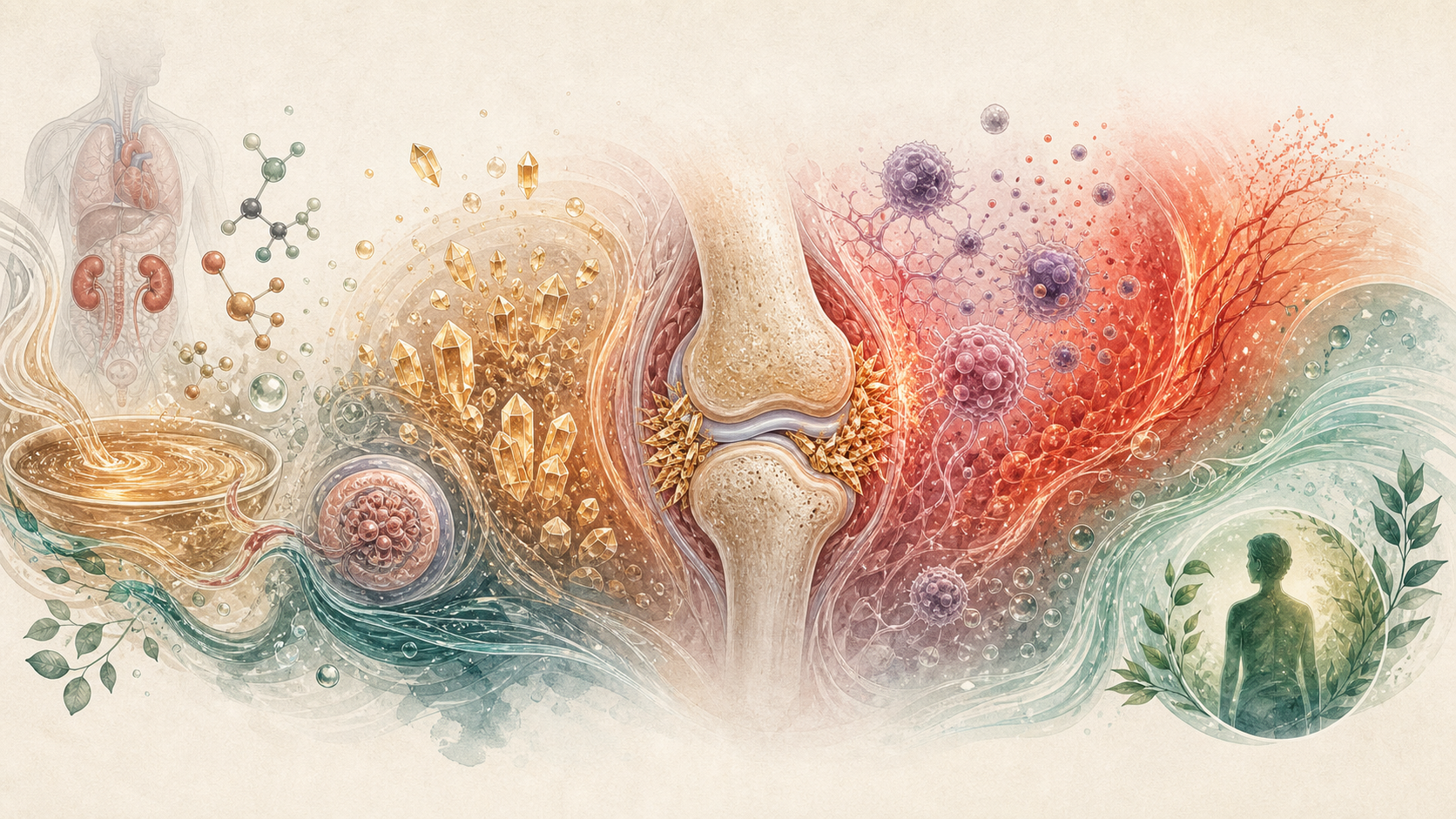
1. Uric acid load
Uric acid is a normal breakdown product. Your body makes it when it processes purines from normal cell turnover and from food. Xanthine oxidase is one enzyme in that production path.
Humans are unusual because we lost functional uricase, the enzyme most mammals use to break uric acid down further. That does not make gout destiny. It means humans live closer to the chemistry where urate can crystallize.
2. Clearance decides how much stays
Uric acid has to leave the body. The kidneys handle much of that work, but the gut is part of the clearance system too. Transporters such as URAT1, GLUT9, and ABCG2 help decide whether urate is reabsorbed, secreted, or moved into the gut.
This is why gout is not just a food problem. Food can matter. Alcohol, concentrated fructose, dehydration, and large purine loads can matter. But the bigger question is what your body does with urate over time.
3. Urate can cross the crystal-forming range
When serum urate stays above the crystal-forming range, urate is more likely to leave solution and form monosodium urate crystals.
Standard gout care usually uses a serum urate target below 6 mg/dL for long-term control. Some people with more severe crystal burden may need a lower target. The exact plan belongs in a prescribing conversation, but the concept is simple: the number matters because crystals form and dissolve according to chemistry, not willpower.
Evidence label: serum urate targets and treat-to-target care are current care. The crystal-forming range is chemistry, which is why the number matters even when pain is quiet.
4. Crystals can be quiet
Crystals make flares possible, but crystals are not the whole flare.
Some people have high uric acid without gout symptoms. Some people have deposits that sit quietly between flares. Pain going away after a flare does not prove the crystal burden is gone. It usually means the inflammatory episode has quieted down.
5. The immune system flips the flare on
Monosodium urate crystals can activate the innate immune system. Several signals matter here: complement activation, C5a priming, NLRP3 assembly, IL-1 beta signaling, neutrophil recruitment, and resolution pathways.
Plain English version: the immune system sees the crystal context as danger. Once that cascade turns on, the joint can become hot, swollen, red, stiff, and intensely painful.
6. Different choices hit different rungs
This is where gout starts to make more sense.
Some choices lower uric acid burden. Some affect urate handling. Some reduce flare priming. Some interrupt inflammation during a flare. Some protect the joint while it calms down. Some help you track the pattern so the next clinician conversation is sharper.
A random stack is guessing. A useful plan asks: what am I trying to change, what evidence supports this lever, and how will I know if it helped?
Why one trigger rarely explains everything
People often notice a pattern: shellfish, beer, restaurant food, dehydration, hard exercise, fasting, injury, illness, poor sleep, travel, medication changes.
Those observations are worth taking seriously. They are clues. But a trigger usually lands on top of a prepared system. The joint was already vulnerable because urate, crystal deposits, local tissue stress, and immune priming were already part of the story.
So the better question is not only "what triggered this?" It is:
- Was uric acid above target over time?
- Was there dehydration, alcohol, concentrated fructose, fasting, illness, trauma, or hard mechanical stress?
- Did any medication, hormone change, kidney change, or gut issue shift urate handling?
- Did this flare follow the usual pattern, or is something different?
Why people differ
Two people can eat the same meal and have different outcomes.
Genetics can change urate transport. Kidney function can change clearance. Gut transport and microbiome context can change how much urate leaves through the intestine. Hormones can interact with urate-handling pathways. Medications can shift uric acid or flare risk. Comorbidities such as chronic kidney disease, hypertension, insulin resistance, and cardiovascular disease can change the whole care picture.
That does not mean every person needs genetic testing or a complicated workup. It means your pattern matters. If the pattern is unusual, severe, early, familial, medication-linked, hormone-linked, or hard to control, the right question is more specific than "what food should I stop eating?"
What this means for action
If you are in pain right now, use the flare path. The immediate job is to protect the joint, reduce inflammation, use the rescue plan you already have, and check whether this fits your usual pattern.
If this is your first hot, swollen joint, or you have fever, chills, a wound near the joint, recent trauma, severe illness, immune suppression, or a pattern that feels different from your usual gout, treat it as more urgent than a familiar flare. Infection and injury can look like gout from the outside.
If you are between flares, the job changes. Write down what happened: date, joint, pain level, possible context, medicines used, what helped, what rebounded, and whether the same joint keeps coming back. Then connect the event to the long-term question: what is your uric acid target, when will it be rechecked, and what plan is supposed to get you there?
Questions worth bringing forward
- What uric acid target are we treating to?
- When should serum urate be rechecked?
- Does my flare pattern suggest crystal burden that needs long-term prevention?
- Could my kidney function, medications, hormone context, or recent medication change be affecting uric acid or flare risk?
- If I flare again, what is my rescue plan and when should I use it?
- If this keeps happening in the same joint, should we ask about imaging or tophi?
Use the chain to choose the next page
- If the joint hurts now, the job is flare care: protect the joint, check the pattern, and use the plan that fits.
- If the pain is dropping, the job is recovery: prevent rebound and record what happened.
- If flares are repeating, the job is prevention: serum urate target, crystal burden, flare threshold, and clinician questions.
- If a meal, drink, workout, medication, hormone change, or weird context seems connected, the job is trigger testing, not instant blame.
- If you are considering a supplement, product, or prescription category, the job is intervention mapping: mechanism, evidence tier, fit check, and signal.
Where to go next
- If you want the number that matters, read how uric acid works.
- If you want the pain mechanism, read why crystals and flares are not the same thing.
- If you are in pain now, use the flare-now guide.
- If you want to turn this into a better appointment, use the visit-prep guide.
Sources and deeper reading
Mechanism source links:
- Gout pathophysiology: purine metabolism, urate handling, crystallization, inflammatory cascade, and treatment landscape.
- Gout deep dive: broader why-it-happens context and future-direction research.
- Gout action guide: state-based action framing and intervention mapping.
- Gout genetic variants: why urate handling and flare biology differ across people.
- NLRP3 inflammasome: inflammasome biology and gout-relevant chokepoints.
- Complement C5a in gout: complement priming, C5a, and upstream flare activation.
Standard-care baseline anchors checked for this draft:
- American College of Rheumatology patient page on gout: gout definition, common treatment categories, and patient-facing uric acid target language. Updated February 2025.
- American College of Rheumatology 2020 guideline summary: treat-to-target framing and serum urate target below 6 mg/dL for people on urate-lowering therapy.
- NICE NG219 recommendations: diagnosis, flare management, treat-to-target ULT, target serum urate, and follow-up after flares.