Short answer
A gout trigger is usually the thing that tipped a prepared system, not the whole explanation. Alcohol, concentrated fructose, dehydration, fasting, illness, poor sleep, injury, mechanical stress, medication changes, and hormone shifts can matter because they can move urate, tissue stress, or immune priming around existing crystals. If you are in pain now, use the flare-now guide; after the flare settles, use a small trigger log so you can separate one-off noise from a repeatable pattern.
Evidence label: alcohol, purine-rich foods, high-fructose drinks, medicines, and comorbidities are current-care risk context; ketosis, BHB, NLRP3, and structured self-experiment logic are mechanism and pattern-tracking evidence.
Trigger stories are usually trying to tell you something. They are also easy to overread.
"It was shellfish."
"It was beer."
"It was the cheap restaurant oil."
"It was the long walk."
Maybe. Better question: what did that event change in a body that was already vulnerable?
Why this framing is solid:
- Current care: alcohol, purine-rich foods, high-fructose drinks, body weight, comorbidities, and medicines can affect gout risk; flares deserve follow-up and serum urate review.
- Mechanism evidence: fructose-driven urate production, ketosis and BHB paradox, urate handling, crystal burden, and NLRP3 inflammatory activation.
- Pattern evidence: structured n-of-1 tracking preserves signal without turning life into a food prison.
After a flare settles, check serum urate, kidney/cardiometabolic context, rapid weight change, medications, and prevention if flares are repeating.
A trigger lands on a prepared system
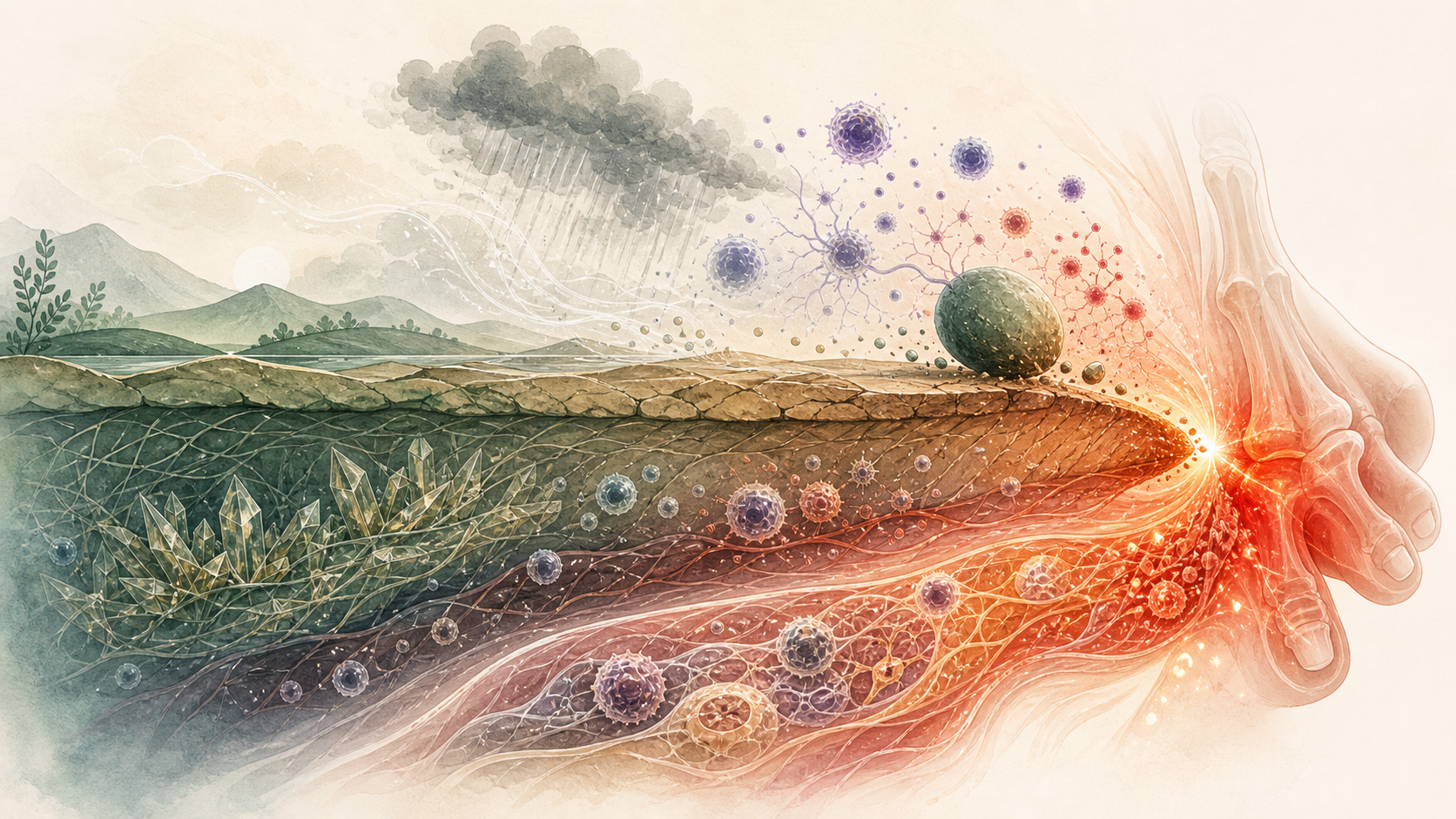
A trigger is the thing you notice right before the flare. It is not always the root cause.
The prepared system is everything that made the flare possible before that moment:
- urate above target over time
- crystal deposits in or around the joint
- local tissue stress
- dehydration or changing blood volume
- illness, poor sleep, or systemic inflammation
- alcohol, fructose, fasting, ketosis, or medication changes
- immune priming around the crystal context
The trigger may be real. It may be the last shove. But if the substrate was not there, the same shove might have done nothing.
Common trigger categories
Alcohol
Alcohol can change hydration, metabolism, sleep, appetite, and behavior around food. Beer also brings purine load. For some people, alcohol is one of the cleanest patterns in the log.
The action is not moral. It is pattern recognition: what kind, how much, with what food, after what sleep, and what happened next?
Evidence label: standard-care supported risk factor, with person-specific dose and context signal.
Concentrated fructose
Fructose is not just "sugar." In large concentrated doses, it can push ATP depletion and purine production toward uric acid.
Soda, high-fructose corn syrup, big sweet drinks, and fruit juice belong in the same trigger bucket. Whole fruit is a different exposure because the dose and package are different.
Evidence label: standard-care risk factor plus mechanism evidence.
Dehydration
Dehydration can concentrate serum urate and stress the joint environment. Travel, alcohol, heat, hard exercise, sauna, poor intake, and illness can all move this lever.
Evidence label: standard-care context and n-of-1 pattern signal.
Fasting, ketosis, and rapid weight change
This is where the old advice gets too flat.
Ketosis can transiently raise serum urate because ketones compete with urate handling. At the same time, beta-hydroxybutyrate is an interesting NLRP3 signal with anti-inflammatory mechanisms.
So the question is not "fasting good or bad?" It is: what state are you in, what is your urate burden, are crystals likely present, are you actively flaring, and are you measuring anything?
Ketosis and BHB are not pain-now rescue tools. The urate-rise side can matter during an active or prodromal flare, while the NLRP3 side remains a plausible mechanism rather than proven human gout treatment.
Checks to bring forward:
- Am I actively flaring or in prodrome?
- What is my serum urate trend?
- What is my kidney function?
- Do I have diabetes, insulin use, SGLT2 inhibitor use, or another ketosis-relevant risk?
- If fasting or ketosis is part of my plan, what should we monitor and what would make us stop that experiment?
Illness, sleep, trauma, and mechanical stress
A flare can follow an infection, surgery, injury, poor sleep, or a hard mechanical day on the joint. These events can change inflammation, fluid balance, immune priming, and local tissue stress.
So "I just walked too much" can be partly true without being the whole diagnosis.
Overwork deserves a real slot in the log. In a Qingdao acute-flare cohort, fatigue or overwork was a much more common patient-attributed trigger than trauma. That does not prove one walk caused one flare. It says long days, hard training, travel, poor sleep, heat, recovery debt, and a joint that was already sensitive deserve to be logged together.
Night timing matters too. Gout attacks cluster overnight in published case-crossover data, with midnight to morning onset more common than daytime onset. That fits the lived pattern where a day's exposures show up after hours, not always while the joint is being loaded.
Evidence label: illness and trauma are standard-care context; nocturnal onset and mechanical-overwork patterns have human observational support; your own repeat log decides whether the lever is personal.
Medication and hormone changes
Diuretics, urate-lowering therapy changes, immunosuppressive changes, hormone shifts, and other medication moves can change the gout landscape. This is one of the places where a good log beats memory.
Bring the medication or supplement name, dose, start date, stop date, dose-change date, flare timeline, serum urate trend, kidney function, and major comorbidities.
The clinician question is specific: could this medication, dose change, or hormone shift be affecting urate or flare risk, and what should we monitor or adjust?
How to handle a weird theory
Suppose a friend says, "I think cheap restaurant oil triggers it for me."
The useful response is not dismissal. It is placement.
What else was in that meal or context?
- beer or alcohol
- sweet sauce or soda
- high salt and low water
- late night and poor sleep
- fried food plus large portion size
- dehydration from travel or heat
- a long walk before or after
- a joint that had already been grumbling
Maybe a specific oil matters for that person. Maybe the real signal is the surrounding pattern. The point is to test the story instead of swallowing it whole.
Evidence label: this is n-of-1 hypothesis territory. Keep the observation, test the co-exposures, and look for repetition.
Track enough, not everything
A useful trigger log is small enough to keep during real life.
For each flare or near-flare, capture:
- date and time of onset
- joint
- normal baseline for that joint and the threshold that made you act
- pain score from zero to ten
- usual pattern or new pattern
- alcohol in the prior forty-eight hours
- concentrated fructose in the prior forty-eight hours
- dehydration, heat, travel, or poor fluid intake
- fasting, ketosis, rapid weight change, or heavy exercise
- illness, sleep disruption, injury, surgery, or mechanical overload
- medicine or supplement changes
- serum urate if available
- rescue used
- response and rebound
Then look for repeatable patterns. One event is a clue. Three similar events start to become a signal.
Worksheet handoff: use the forty-eight-hour trigger review when you are tempted to blame one food or one event. Use the flare record when the details are still fresh.
Change one thing at a time when you can
If you change five variables and the flare pattern improves, you still helped yourself. You just learned less.
When the situation allows it, change one lever and track the result. Remove soda first. Tighten alcohol next. Add a supplement later. Adjust training load separately. This is not because life is a lab. It is because a clean signal saves you from chasing every rumor.
For supplement or product experiments, the same rule applies: name the intended mechanism, choose the outcome, define the tracking window, and check whether the result matches the claim.
Use the trigger story without getting trapped by it
After a flare, write one clean version of the theory:
I think [possible trigger] mattered because [mechanism or context], and I will check it against [signal] over [next few flares or weeks].
Then test the surrounding context before blaming one thing forever:
- Was serum urate above target or unknown?
- Was the joint already grumbling?
- Did alcohol, fructose, dehydration, fasting, illness, sleep, travel, training, medication, or hormone context stack around the same time?
- Did the same pattern repeat?
- Did changing one lever change the next flare pattern?
Where to go next
- If you need the upstream number, read how uric acid works.
- If you want to understand why a quiet joint flares, read crystals and flares.
- If you want to decide where an intervention fits, use the intervention map.
- If you are trying to prevent the next event, read preventing the next flare.
- If the joint is still recovering, read what to do after the pain stops.
- If you need to turn the pattern into clinician questions, use the visit-prep guide.
- If you are in pain now, use the flare-now guide.
Sources and deeper reading
Mechanism and tracking source links:
- Gout action guide
- Fructose connection
- Beta-hydroxybutyrate
- Self-experiment protocol
- Gout pathophysiology
- Androgen-urate axis
- Mechanical flare triggers
Standard-care baseline anchors checked for this draft:
- American College of Rheumatology patient page on gout: updated February 2025.
- NICE NG219 recommendations
- CDC gout overview
- Nocturnal risk of gout attacks: human case-crossover evidence for overnight flare timing.