Short answer
When gout pain starts dropping, do not treat the joint as normal yet. A recovering joint can feel much better while heat, swelling, stiffness, sleep disruption, and guarded walking still say "not ready." Move by layers, use the next morning as the rebound check, and record your baseline, action threshold, rescue response, and possible prior-48-hour context before memory blurs.
Evidence label: return-to-activity advice is standard-care joint protection plus practical tracking; serum urate targets and medication questions below are standard-care visit topics.
When a flare starts improving, the question changes from "how do I survive this?" to "how do I get back to normal without setting it off again?"
Do these three things first:
- Move by layers, not by impatience.
- Use the next morning as the gate.
- Write the flare record while it is fresh.
First, check the state
Use this page when the flare is improving, mostly settled, or newly quiet.
If pain control is still the urgent problem, use the flare-now guide. If you are deciding whether to exercise during an active foot flare, use exercise during a flare.
If this was your first hot, swollen joint, or there was fever, chills, a wound near the joint, recent trauma, severe illness, immune suppression, or a pattern that felt different, treat the event as more than a familiar flare. Infection and injury can look like gout from the outside. Get same-day medical evaluation if that has not already happened.
What "quiet" means
Use more than "less awful" as the return-to-normal signal.
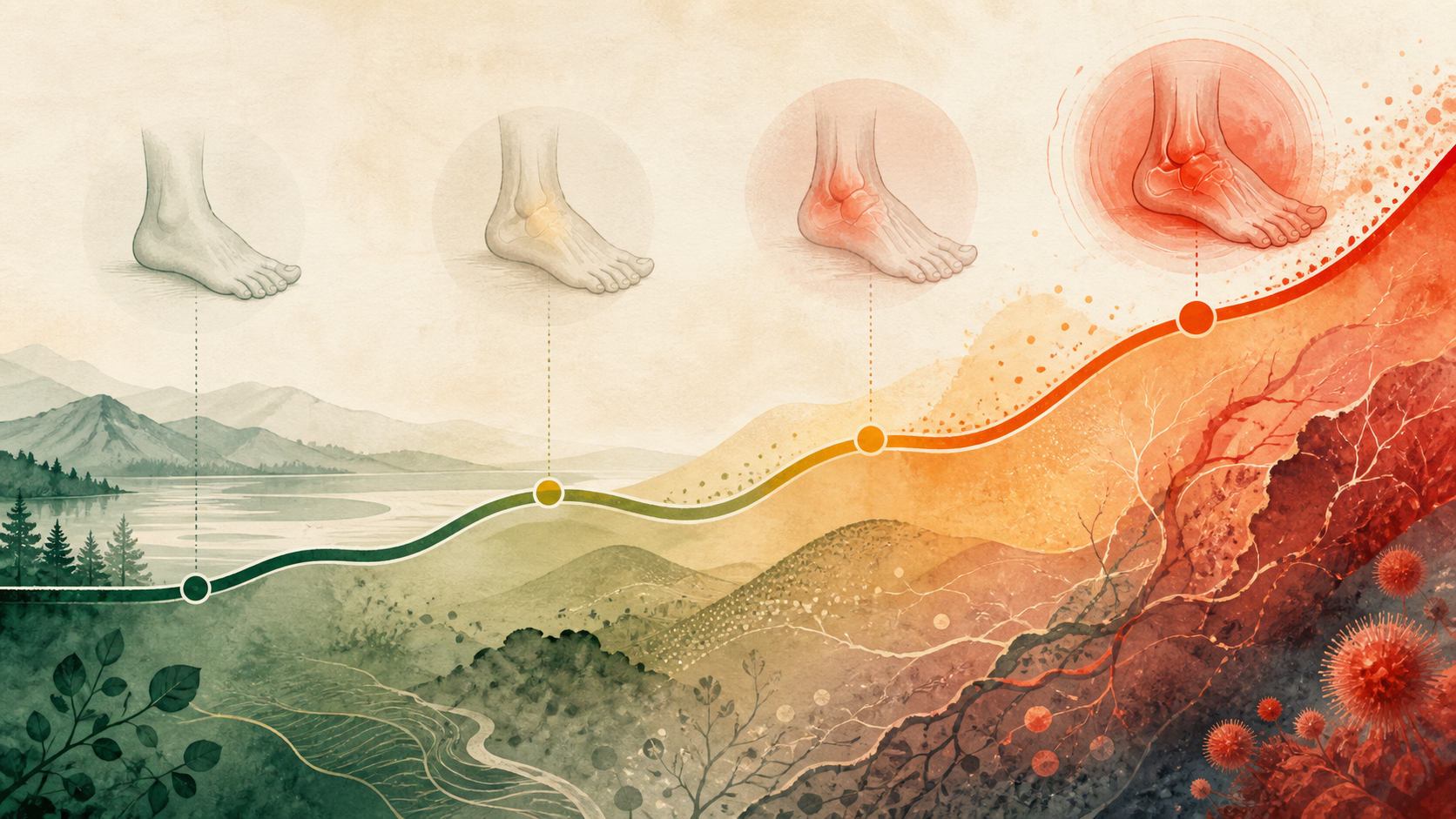
Baseline means your normal-for-you joint state, not zero. A stable day may be zero, one, three, or higher.
The useful signal is change from your baseline: more pain, new heat, new swelling, more stiffness, a limp, a change in shoe tolerance, or the familiar climb that has preceded bigger flares for you.
Use a stricter test. A joint is quiet enough to move forward when:
- pain at rest is near your own baseline
- swelling is clearly down
- heat and redness are clearly down
- you can walk indoors without limping or protecting the joint
- normal touch, sock pressure, or shoe pressure does not make the joint pulse
- the next morning is the same or better after ordinary activity
The limp matters. If you are still changing your gait around the joint, the joint is still running the show.
For a wrist, elbow, knee, or finger flare, translate the same test: normal use without guarding, gripping, kneeling, stairs, typing, lifting, or bracing around the painful joint.
Your action threshold is personal. Write down your ladder: baseline, watch zone, action zone, flare zone. Name what each level means for you, from back off and watch to use the rescue plan.
If your baseline is already high, treat that as information. Bring it to the visit-prep guide: daily pain floor, walking or use limits, same-joint recurrence, urate trend, and whether imaging or prevention needs a sharper plan.
Return by layers
Return to activity by response, not by calendar.
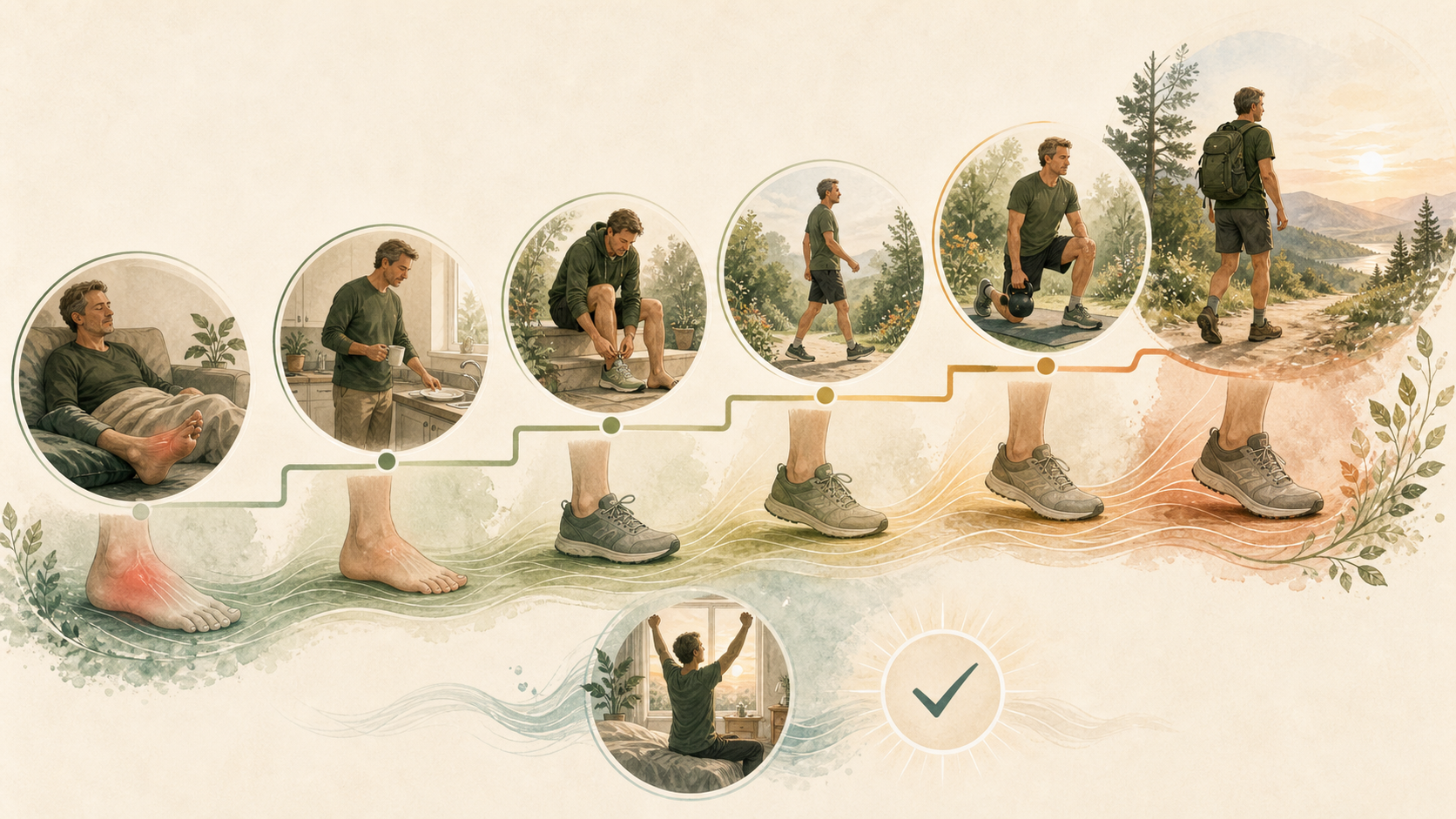
The gate is the next day. Move up a layer only when the current layer produces no same-day or next-morning rebound.
- Quiet at rest. The joint can be uncovered, elevated, cooled if needed, and left alone without throbbing.
- Normal household movement. Bathroom, kitchen, short indoor movement, no limp.
- Normal shoe and short walk. The shoe does not squeeze the flare site. The walk stays short enough that gait remains normal.
- Range of motion and easy mobility. Gentle movement, no forced stretching into the painful joint.
- Light training. Easy effort, no impact, no loaded push through the affected joint, no heat/dehydration session.
- Normal training. Only after the joint stays quiet the next morning.
If pain, swelling, heat, or stiffness rebounds mildly, step back to the last layer that stayed quiet. If pain, heat, or swelling meaningfully returns, resume the flare plan or return to the flare-now guide. If it worsens, feels different, or the rescue plan is not working, get medical evaluation.
The almost-better trap
The risky moment is not always the first day of pain. It is often the day you feel human again.
Walking farther, standing longer, wearing the wrong shoe, doing yard work, playing a round, pushing lower-body training, or turning a quick errand into a load test can all create a rebound signal.
That does not mean the flare "came back from nowhere." It may mean the joint was quiet enough to tempt you and not quiet enough to carry the load.
If you are on a prescribed taper or written rescue plan, treat that window as recovery time, not a victory lap. If the plan does not name an activity boundary, ask: "While I am on this taper or rescue plan, what activity level is okay, and what signs mean I should step back or call?"
Sleep is a recovery gate
Do not call the joint ready just because daytime pain improved after a bad night.
If sleep is still broken by throbbing, bedding contact, bathroom trips, or the need to keep a foot outside the bed and untouched, stay in a lower recovery layer the next day. If a cannabis product helped pain or sleep, record product, route, timing, next-morning fog, and impairment risk. If you use melatonin, treat it as sleep timing, not pain control and not proof the joint is load-ready.
Evidence label: sleep notes here are state-tracking and recovery logic. Cannabinoid mechanism details belong on the flare and rescue-kit pages; this page uses the next-morning function signal.
Use the resolution window on purpose
When the pain peak has clearly passed, the job changes. You are no longer trying to overpower a full flare with a new product. You are trying to support clean resolution while the joint is still touchy.
Omega-3 is one example. EPA and DHA are raw materials for specialized pro-resolving mediators such as resolvins and maresins. Those mediators help switch inflammation toward resolution in MSU animal and lab models. A practical experiment, if omega-3 already fits your body, is a defined EPA+DHA target for one to two weeks after the pain peak, often around 2 g/day total EPA+DHA, while tracking swelling, stiffness, rebound, sleep, bruising or bleeding, reflux, and days back to baseline.
This is not a pain-now rescue and not a proven human gout protocol. It is a resolution-window experiment with a signal to watch.
Training after a flare
During a foot flare, upper-body work may fit if the foot is truly out of the workout. That belongs in the exercise-during-flare guide.
After the pain drops, lower-body work returns last.
Start with normal walking mechanics before training load. Then choose movements that keep the affected joint honest:
- easy range of motion before resistance
- low load before heavy load
- controlled movement before impact
- short sessions before normal sessions
- cool, hydrated training before hot, sweaty training
Hard exercise, heat, dehydration, poor sleep, alcohol, and travel can all change the flare context. If one of those shows up before a rebound, log it.
Make the flare record while it is fresh
Memory gets sloppy fast. Write the record before the event turns into a vague story.
Capture:
- date and time of onset
- joint and side
- first symptoms
- normal baseline for that joint and the level that made you act
- peak pain from zero to ten
- swelling, heat, redness, stiffness, or skin sensitivity
- possible context in the prior forty-eight hours: alcohol, concentrated fructose, dehydration, fasting, illness, poor sleep, travel, hard exercise, injury, medication or supplement changes
- rescue used: prescription medicine, OTC medicine, cold therapy, topical, supplement, elevation, rest
- time to meaningful relief
- what preceded rebound, if anything
- days until normal walking
- serum urate result and timing relative to the flare, if available
This keeps the thread between flares.
Worksheets that help
Use the tools and worksheets page for:
- Flare record: capture the event before memory blurs.
- Baseline ladder: define baseline, watch zone, action zone, and flare zone.
- Return-to-activity ladder: choose today's recovery layer.
- Doctor visit worksheet: turn the flare into questions, notes, and next steps.
Turn the flare into a better plan
After a flare settles, the useful question changes from "what gets me through today?" to "what lowers the chance this keeps happening?"
Bring these questions forward:
- What serum urate target are we treating to?
- When should serum urate be checked or repeated?
- If serum urate was normal during the flare, should it be repeated after the flare has settled?
- Do repeated flares, same-joint flares, or lingering swelling suggest imaging or tophi evaluation?
- Does kidney function, blood pressure, diabetes risk, diuretics, alcohol, fructose, rapid weight change, hormone context, or training load change the plan?
- What is the rescue plan for the next flare?
- If flares are repeating, should long-term urate-lowering therapy or flare-protection strategy be reviewed?
Source label: standard-care gout sources support treat-to-target serum urate conversations, repeat-testing questions, flare-frequency follow-up, and tophi/imaging discussion. These are appointment questions, not self-adjustment commands.
Repeated rescue use is not a character flaw. It is a signal that the prevention plan deserves attention.
The useful rule
Treat the quieting joint like recovering tissue.
Pain down means the emergency is easing. It does not prove the crystal burden is gone, the immune response is fully resolved, or the joint is ready for normal load.
Move by layers. Watch the next-day response. Record the flare. Use the quiet period to push the long-term question: what is keeping urate high enough, long enough, and what is keeping the immune system ready to flare?
Where to go next
- If pain control is still the urgent problem, use the flare-now guide.
- If you are deciding whether to train during an active flare in the foot, use the exercise-during-flare guide.
- If you want to understand why pain relief is not crystal dissolution, read why crystals can flare.
- If you want to place a trigger or rebound pattern, read the trigger-pattern guide.
- If flares are repeating, use the prevention guide.
- If you need to turn the event into appointment questions, use the visit-prep guide.
Sources and deeper reading
Mechanism and tracking source links:
Standard-care baseline anchors checked for this draft: