Short answer
Uric acid is a normal breakdown product, not a toxin your body is supposed to have at zero. Gout risk rises when serum urate stays high enough for long enough that monosodium urate crystals can form or persist. The number matters because long-term gout control usually means getting below a target and staying there, while remembering that an in-flare lab can read lower than the real between-flare pattern. If you are in pain now, use the flare-now guide; if this is a first, feverish, injured, wounded, immune-suppressed, or different-pattern joint, same-day evaluation is the safer fork.
Evidence label: serum urate measurement and treat-to-target care are current care. Production, kidney clearance, gut clearance, and transporter biology explain why the number differs so much from person to person.
The useful question is: why is urate staying high enough, long enough, in this body, for crystals to form or persist?
Route check: if you are in pain now, use the flare-now guide. If this is your first hot, swollen joint, or there is fever, chills, a wound near the joint, recent trauma, severe illness, immune suppression, or a pattern that feels different, get same-day medical evaluation.
Why this framing is solid:
- Current care: serum urate measurement, treat-to-target urate lowering, and common urate-lowering categories.
- Mechanism evidence: purine metabolism, fructose-driven urate production, kidney and gut clearance, transporter biology, and hormone context.
- Research frontier: gut-lumen urate disposal, ABCG2 modulation, purine-degrading bacteria, and genotype-aware intervention logic.
Where uric acid comes from
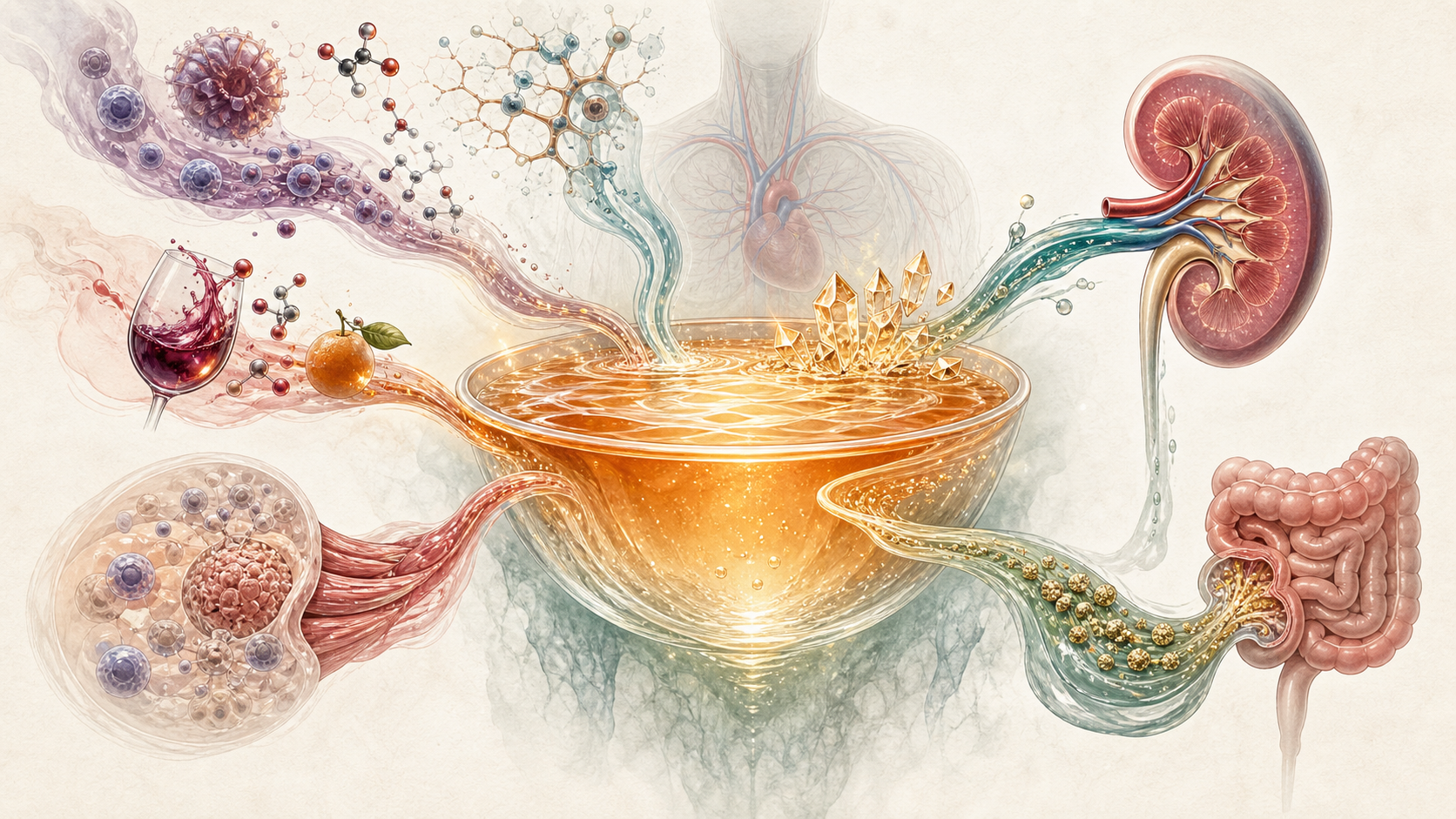
Your body makes uric acid every day. That is normal.
Uric acid is the end product of purine breakdown in humans. Purines come from normal cell turnover and from food. Xanthine oxidase is one enzyme in the production path, which is why some standard medicines target that enzyme.
Humans are odd here. Most mammals have uricase, an enzyme that breaks uric acid into allantoin, a more soluble molecule that leaves the body more easily. Humans, great apes, and a few other primates lost functional uricase. That means humans run closer to the chemistry where urate can leave solution and form crystals.
This does not make gout inevitable. It means the margin is thinner.
Evidence label: purine breakdown, xanthine oxidase, and uricase loss are mechanism biology. Xanthine oxidase inhibition is current-care medication territory.
Fructose is different from generic "sugar"
Fructose deserves special attention because fructose metabolism can drain ATP, raise AMP, and push purine production toward uric acid. That is different from saying "all carbs are gout triggers" or "one sweet thing caused the flare."
Concentrated fructose is the main concern: soda, high-fructose corn syrup, large sugar-sweetened drinks, and fruit juice. Whole fruit is a different package because it comes with fiber, water, and a much smaller dose per serving.
The point is not food moralizing. The point is mechanism. Fructose can increase uric acid production and can interact with urate transport biology.
Evidence label: high-fructose drinks are a standard-care risk factor. The ATP/AMP/purine-synthesis chain is mechanism evidence for why concentrated fructose deserves special attention.
Clearance decides what stays
Uric acid has to leave the body. The kidneys do a large share of the work. The gut also matters.
Kidney handling is not a simple drain. Urate is filtered, reabsorbed, and secreted through transporters. URAT1, GLUT9, OAT transporters, and other proteins help decide how much urate returns to the blood and how much leaves.
The gut is part of the clearance system too. ABCG2 moves urate into the intestinal lumen. One research direction treats this as gut urate disposal: in principle, increasing urate movement into the gut or degrading urate there could change the body-wide urate balance.
That is why gout is usually more of an under-clearance problem than an overproduction problem. Food can raise the load. The clearance machinery decides whether the load becomes chronic chemistry.
Evidence label: kidney urate handling is current physiology and current-care context. Gut-disposal, ABCG2, purine-degrading bacteria, butyrate, and fiber logic are mechanism evidence and research-direction evidence.
Patient-useful translation:
- Ask how kidney function, diuretics, blood pressure medicines, and stone history affect the urate plan.
- Track serum urate after major diet, medicine, supplement, antibiotic, or gut-health changes.
- Treat generic probiotic claims as unproven until the strain, mechanism, and outcome are named.
Why the number matters over time
Urate stays dissolved only up to a point. Around 6.8 mg/dL under physiologic conditions, urate becomes more likely to come out of solution and form monosodium urate crystals.
That number is chemistry. It is not a character judgment.
Standard gout care usually treats to a serum urate target below 6 mg/dL for long-term control. ACR uses below 6 as the central treat-to-target anchor. NICE also says to consider below 5 for people with tophi, chronic gouty arthritis, or ongoing frequent flares despite reaching below 6. The reason is simple: stay low enough for long enough that new crystals stop forming and existing deposits can dissolve.
A single lab value can mislead in both directions. Serum urate can be lower during a flare than it is between flares. One high number does not tell the full history. One "normal range" result does not prove the tissue crystal problem is solved.
Evidence label: below 6 mg/dL as a central target is current-care guidance. Considering a lower target for tophi, chronic gouty arthritis, or frequent flares is also guideline territory, not supplement logic.
The better pattern is serial measurement: what is the number, what is the target, what changed, and what happened next?
The number is personal because the machinery is personal
Two people can eat the same dinner and get different urate responses.
Genetics can change transporter function. ABCG2 variants can reduce gut and kidney urate secretion. GLUT9 and URAT1 variation can change renal handling. Hormone context can interact with urate transport. Kidney function, blood pressure medicines, diuretics, insulin resistance, alcohol, dehydration, training load, and illness can all shift the system.
This is why "just eat less shellfish" is such a thin answer. Shellfish can matter for some people. It is not the whole engine.
The engine has inputs, production enzymes, clearance routes, transporters, crystal chemistry, and immune activation downstream.
Evidence label: transporter genetics and hormone-axis logic are mechanism evidence unless a clinician has tied them to your care plan. They are reasons to ask sharper questions, not reasons to guess.
What you can bring to a visit
The most useful uric acid conversation is concrete.
- What was my serum urate during the flare and after it settled?
- What target are we treating to?
- When should it be rechecked?
- Do my kidney function, medications, alcohol pattern, fructose intake, weight changes, or recent illness change the interpretation?
- Does my pattern suggest under-clearance, overproduction, or a mixed picture?
- What do my eGFR, CKD status, diuretics, blood pressure medicines, and stone history imply?
- Would FEUA, twenty-four-hour urine uric acid, imaging, or joint fluid testing clarify the picture?
- Does early-onset, family history, resistant hyperuricemia, or repeated same-joint flaring change what we check?
- Could hormone medicines, menopause, testosterone context, or other endocrine shifts be part of the urate pattern?
- If my urate is near target but flares continue, what do we think is still happening?
If you are tracking on your own, keep it simple:
- date
- serum urate value
- whether you were in a flare
- recent alcohol, fructose, dehydration, fasting, illness, hard exercise, or medication changes
- what intervention changed
- what happened to pain and flare frequency afterward
Use this page when a number needs context
Use the uric-acid model when you are trying to decide what a lab value means.
- If the number was taken during a flare, ask whether it should be repeated after the flare settles.
- If the number is above target, ask what plan is supposed to lower it and when it will be rechecked.
- If the number is near target but flares continue, ask whether crystal burden, timing, imaging, or the flare threshold still explains the pattern.
- If a diet, medication, hormone, supplement, alcohol, fructose, gut, or kidney change happened, put it on the timeline next to the urate value.
- If you are testing a lever, track serum urate over weeks to months, not one isolated day.
Where to go next
- If you want to understand why crystals can be quiet until a flare explodes, read crystals and flares.
- If you are trying to make sense of a possible trigger, read how triggers work.
- If you want to compare interventions by mechanism and state, use the intervention map.
- If you need to turn labs into a better appointment, use the visit-prep guide.
- If medication categories are part of the question, read the medications guide.
- If sex or hormone context matters, read the sex-differences guide.
Sources and deeper reading
Mechanism source links:
- Gout pathophysiology
- Fructose connection
- ABCG2 modulators
- Purine-degrading bacteria
- Androgen-urate axis
Standard-care baseline anchors checked for this draft: